Alternatives to quartz countertops
The Case for Enameled Lava Stone
Quartz worktops have become the default choice for a generation of kitchen renovations. They are consistent, easy to maintain, and available in a wide range of colours. For a long time, quartz seemed like the sensible answer to the limitations of granite and marble. But as quartz has become more widespread, its own limitations have come into focus — and more homeowners, designers and architects are looking to go further, seeking a material that meets more precise requirements.
The complaints about quartz are predictable if you have spent time with the material: it does not handle heat well, its colour palette is controlled by manufacturers rather than tailored to your project, and its engineered uniformity — once a selling point — now reads as generic in a market saturated with identical surfaces. Finding a genuine alternative to quartz countertops means finding a material that solves these problems without simply introducing new ones.
Why choose enameled lava stone as a quartz alternative?
Enameled lava stone is one of the few materials that does exactly that. Quarried from the volcanic highlands of Auvergne in central France and hand-crafted by specialist artisans, enameled lava stone is heat-proof, stain-proof, fully customisable, and built to last not years but generations. This page explains why it deserves serious consideration as a quartz alternative — and what sets it apart from the other options on the market.
What Quartz Countertops Do Well — and Where They Let You Down
Quartz countertops are engineered, not natural. They are made from approximately 90% crushed quartz mineral bound with 10% polymer resins. That composition is both their strength and their weakness.
On the positive side, quartz is non-porous straight from the factory. It requires no sealing, resists most household stains, and is available in a consistent, reproducible finish. For buyers who want predictability and low daily maintenance, it delivers on those promises.
The problems surface — sometimes literally — when quartz meets the real conditions of an active kitchen.
Heat is its most significant vulnerability
The polymer resin that holds quartz together is not thermally stable above around 150°C. A hot pan placed directly on a quartz surface can cause discolouration, surface warping, or cracking. This is not a remote risk — it is a documented failure mode that quartz manufacturers quietly acknowledge in their warranty terms. In a kitchen where cooking is taken seriously, this is a meaningful limitation.
Its appearance is manufactured, not mineral
Quartz can mimic the look of marble or concrete, but it cannot replicate the depth and variation of a natural material. Under certain lighting, the engineered uniformity of quartz reads as flat and synthetic. For design projects where material authenticity matters, this is a real constraint.
Customisation is limited to the manufacturer’s range
Quartz comes in slabs of fixed dimensions and a catalogue of pre-set colours. If your project requires a specific shade, an unusual format, or an integrated sink in the same material, quartz will disappoint. You choose from what the manufacturer offers.
UV exposure causes gradual degradation
The resin component of quartz is susceptible to UV light over time. In spaces with significant natural light, or in any outdoor application, quartz will yellow and fade. It is not a material built for the long term in sun-exposed environments.
It has no story
Quartz is an industrial product. It does not come from a specific place, it was not shaped by a specific person, and it carries no craft heritage. For buyers who care about the provenance and meaning of the materials they choose, that absence matters.
The Main Alternatives to Quartz Countertops: An Honest Assessment
Before making the case for enameled lava stone specifically, it is worth surveying the broader field of quartz alternatives — because not every option suits every project.
Granite
Granite is the obvious first move for anyone leaving quartz. It is genuinely natural, durable, and carries real visual variation. Its weakness is porosity: granite requires annual sealing to prevent staining, and its colour palette is limited by geology. It is also, like quartz, now so common in mid-range kitchens that it has lost much of its distinctiveness.
Marble
Marble offers unmatched veining and luxury appeal, but it is a notoriously demanding material in a kitchen context. It etches on contact with acidic foods, stains without immediate attention, and requires consistent sealing. Beautiful and high-maintenance in equal measure.
Porcelain slabs
Porcelain slabs are increasingly popular as a quartz alternative. They are thin, lightweight, non-porous, and suited to contemporary design. They handle heat better than quartz. The limitation is fragility at the edges — porcelain chips — and a manufacturing aesthetic that, like quartz, stops short of genuine material depth.
Concrete
Concrete suits specific design briefs: industrial, raw, tactile. It is heavy, requires sealing, is prone to hairline cracking over time, and demands real maintenance commitment. It also tends to look best in spaces designed specifically around it, rather than adapting to varied contexts.
Sintered stone
Ultra-compact surfaces such as Dekton or Neolith is the most technically advanced quartz alternative on the market. It is heat-resistant, scratch-resistant, and non-porous. Its visual range is broad. The main limitation is cost — sintered stone surfaces are expensive — and a certain industrially engineered quality that places them closer to quartz than to natural materials.
Each of these alternatives addresses some of quartz’s weaknesses. None of them combines full heat resistance, complete colour freedom, zero-maintenance impermeability, natural volcanic origin, and genuine artisanal craft in a single material. That is the specific territory where enameled lava stone operates.
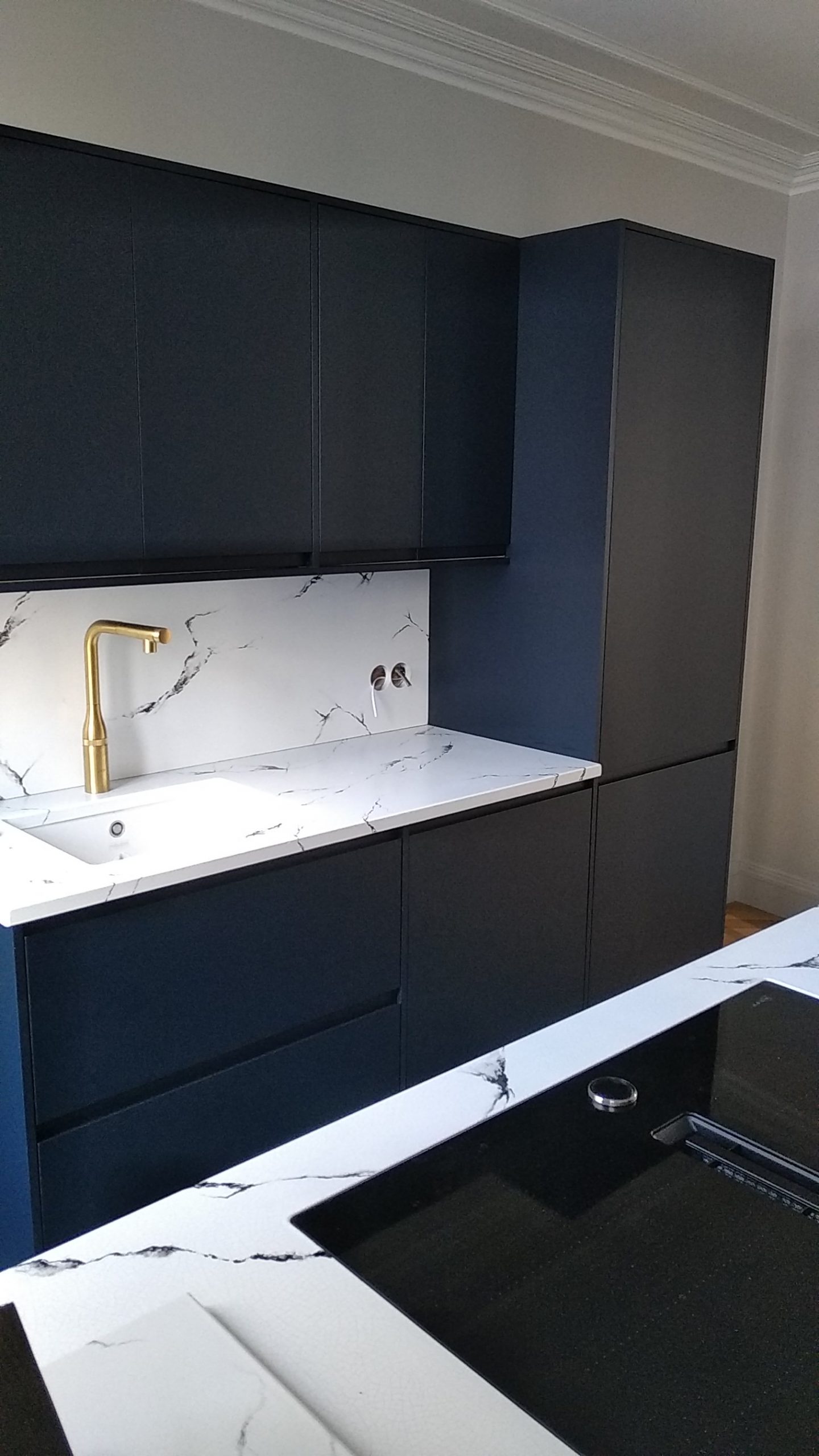
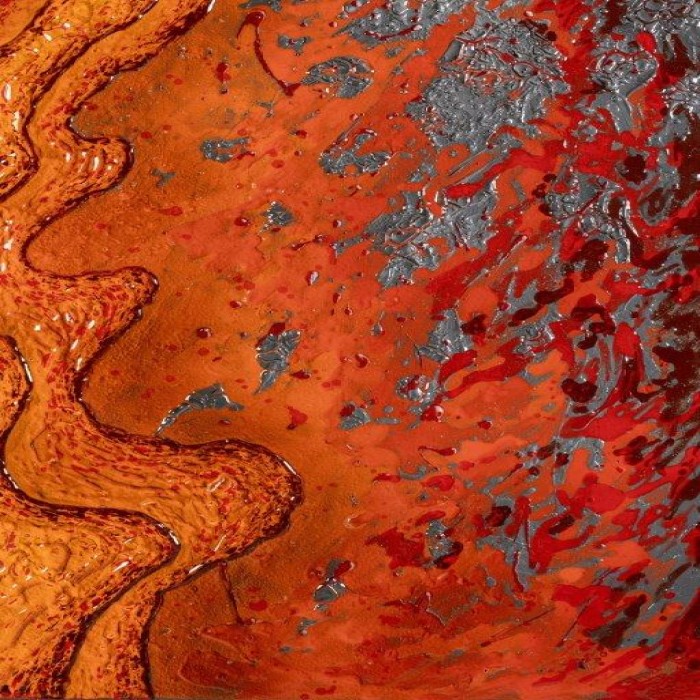
Enameled Lava Stone: The Quartz Alternative Built by Volcanoes and Artisans
Enameled lava stone begins as basalt — dense volcanic rock extracted from quarries in the Auvergne region of France, in the shadow of the Chaîne des Puys, one of Europe’s youngest volcanic chains. The stone is cut to shape, coated with mineral enamel, and fired in a kiln at approximately 960°C. At that temperature, the enamel vitrifies and fuses permanently with the rock surface, producing a material that is at once entirely natural and entirely impermeable.
Not all volcanic stones are equally suited to this process. The basalt from Volvic — a small town north of Clermont-Ferrand — has an unusually fine grain and high thermal stability that allows it to bond with enamel under repeated kiln firings without cracking or shifting. This is why Volvic basalt became, and remains, the reference stone for French enameled lava production.
The technique itself has been practised in Auvergne since the mid-19th century, first for public signage and building facades, then for architecture and interior design. It was never industrialised at scale — it remained, by necessity, a craft. The kiln firing, the enamel application, the stone cutting: each stage requires the judgement and skill of an experienced lava stone enameller. The surfaces that result from this process carry that history with them.
Enameled Lava Stone vs. Quartz: A Direct Comparison
Heat resistance
Quartz fails above 150°C. Enameled lava stone is fired at 960°C and formed from volcanic rock: it handles direct contact with hot pans, baking trays, and cooking vessels without marking, warping, or discolouring. This is a categorical difference, not a marginal one.
Porosity and stain resistance
Quartz is non-porous without any sealing required — this is one of its genuine strengths. Enameled lava stone matches it exactly on this point: the vitrified enamel surface has zero porosity. Nothing penetrates. No sealing is needed, ever.
Scratch resistance
Volvic basalt sits at approximately 6 on the Mohs hardness scale, comparable to quartz mineral. Everyday kitchen use does not mark the surface. The enamel coating adds a glass-hard layer that holds up well to normal contact with utensils and cookware.
Concrete
Concrete suits specific design briefs: industrial, raw, tactile. It is heavy, requires sealing, is prone to hairline cracking over time, and demands real maintenance commitment. It also tends to look best in spaces designed specifically around it, rather than adapting to varied contexts.
Colour and finish customisation
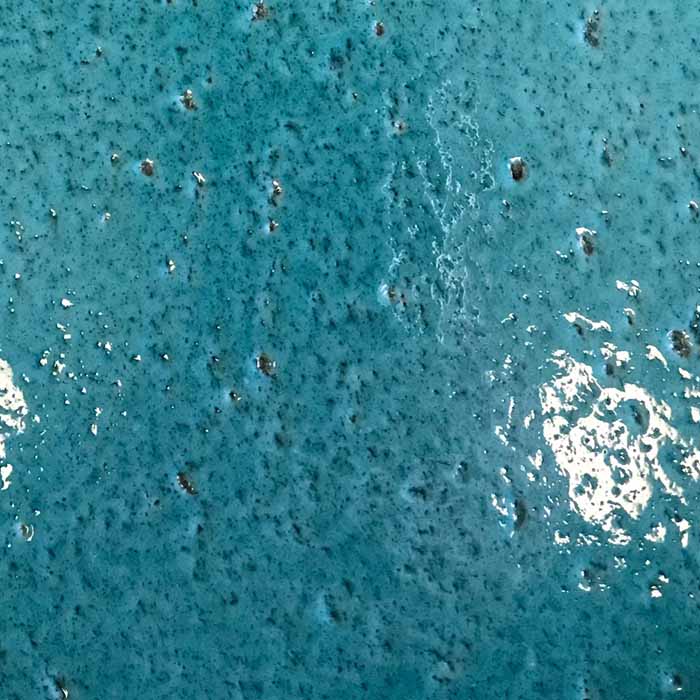
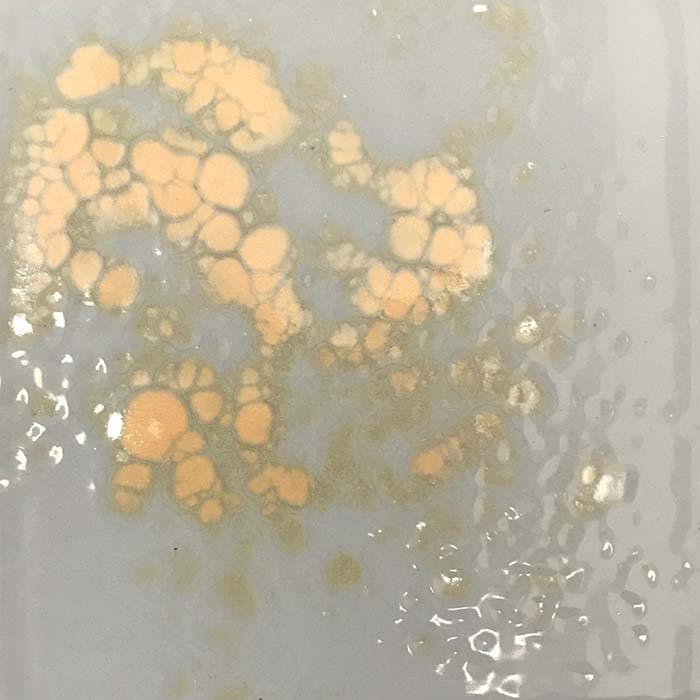
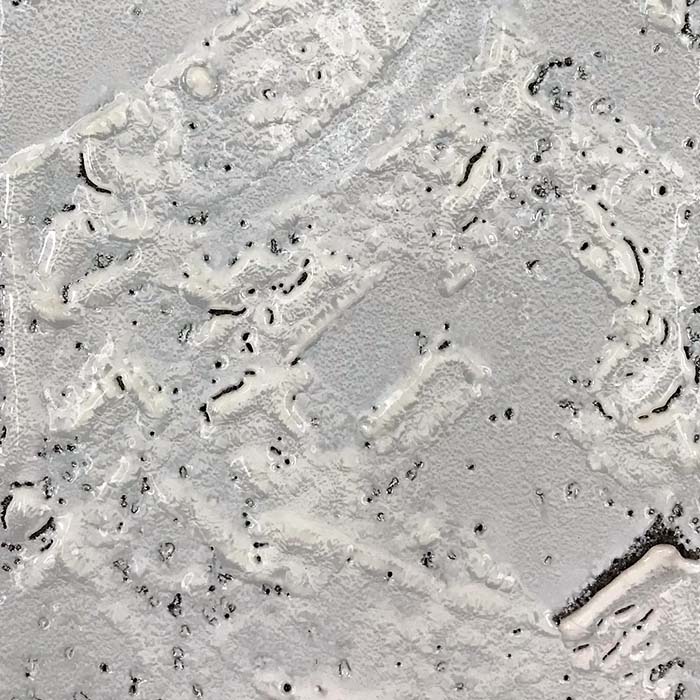
Quartz offers a manufacturer’s catalogue — typically dozens of options, all engineered to look similar across the range. Enameled lava stone offers several custom-formulated shades, available in glossy, matte, metallic, textured, and raku finishes. Each piece is made to your exact specification. If you have a colour in mind that does not exist in any catalogue, it can be formulated.
UV resistance and outdoor use
Quartz degrades in direct sunlight. Enameled lava stone does not: the vitrified enamel surface is fully UV-stable, and the basalt beneath it is unaffected by temperature fluctuation or weather exposure. Lava stone countertops can be used in outdoor kitchens, on terraces, or in any sun-exposed setting without risk of fading or structural degradation.
Longevity
Quartz carries a standard 10 to 15-year warranty from most manufacturers, with real-world durability depending on usage conditions. Enameled lava stone surfaces installed in France’s most significant public buildings over a century ago remain intact today. The facade panels of La Samaritaine in Paris, the mosaics of Fourvière basilica in Lyon, the Paris Metro station signage — all enameled lava stone, all still in place, all still legible. No engineered composite can make that claim. In addition, road direction signs (“Châteauroux 45 km”) were made of enamelled lava until the 1960s, a material already renowned for its robustness and resistance to the elements.
Provenance and craft
Quartz is manufactured globally in large-scale industrial facilities. Enameled lava stone is produced in a small number of specialist workshops in Auvergne, by artisans who master the full production process. It is traceable to a specific region, a specific quarry, a specific set of hands. For buyers for whom material provenance and French craftsmanship carry weight, this distinction is not cosmetic — it is fundamental.
The Finishes Quartz Cannot Offer
One of the clearest advantages of enameled lava stone over quartz is the sheer range of surface possibilities it opens up — many of which have no equivalent in the engineered stone world.
Gloss enamels produce a deeply reflective surface that amplifies kitchen lighting and gives colour a luminous quality. Matte enamels sit at the opposite end of the spectrum: soft, mineral, and close in character to natural unfinished stone. Both are available in any shade across the full colour spectrum.
Metallic finishes — bronze, oxidised brass, dark steel — bring a warmth and complexity to a kitchen surface that no quartz slab approaches. They catch light differently depending on the angle, and they age with a dignity that synthetic surfaces cannot replicate.
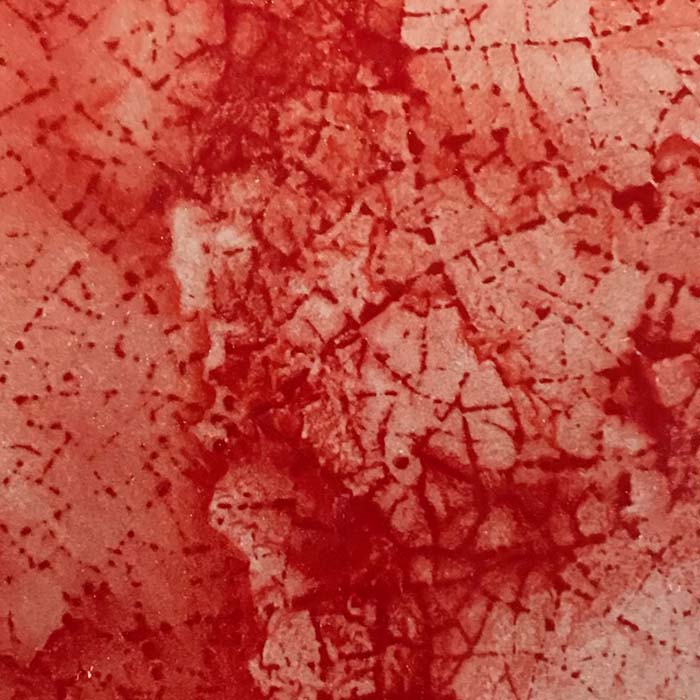
Raku finishes are perhaps the most distinctive option enameled lava stone offers. Borrowed from Japanese ceramic tradition, the raku firing process involves rapidly cooling the piece after kiln removal, causing the enamel to crackle in unpredictable patterns. The result is a surface with organic iridescence and texture that is genuinely unique to each piece. No two raku surfaces are identical. This is the antithesis of the engineered uniformity that defines quartz.
The enamelling technique that produces these finishes is the result of nearly two centuries of craft development in Auvergne. It cannot be replicated by a manufacturing process — which is precisely what makes it valuable.
Who Should Make the Switch from Quartz to Enameled Lava Stone?
Enameled lava stone is not a universal recommendation. It is a considered choice for specific buyers and specific projects.
It suits homeowners who cook seriously and want a surface that handles real kitchen conditions — heat, acids, daily use — without compromise or anxiety. It suits designers and architects who need a countertop material that can be specified to an exact colour, integrated into a broader material palette, and relied upon to hold its appearance for the life of the building.
It suits buyers who are done with surfaces that look the same as everyone else’s. Quartz offered distinctiveness once; it no longer does. Enameled lava stone, made to order in a small artisanal workshop from volcanic rock quarried in central France, offers something that mass production structurally cannot: singularity.
And it suits anyone who thinks in decades rather than product cycles. A lava stone countertop is not something you replace when the kitchen gets renovated again in fifteen years. It is something you keep — because it will still look exactly as it did the day it was installed, and because nothing about it will have dated.
Practical Realities: What to Expect When Choosing Enameled Lava Stone
Choosing enameled lava stone over quartz involves a different kind of purchasing process — one that resembles commissioning a piece rather than selecting from a range.
It is made to order
Dimensions, colour, finish, edge profile, cutouts for sinks and appliances — all of this is specified before production begins. Lead times typically run between four and eight weeks from confirmed order to delivery. This is longer than a standard quartz slab, and it is worth planning accordingly.
It is heavier than quartz
Enameled lava stone countertops are typically 30 to 40mm thick for a solid worktop. Cabinet structures need to be assessed for load-bearing capacity before installation. Tradition Pierre provides technical specifications to support this planning stage.
Maintenance is genuinely minimal
A damp cloth cleans the surface after cooking. Standard household products — including mild acidic cleaners — present no risk to the vitrified enamel. No sealing, no annual treatment, no specialist product. The surface is self-sufficient from the day it is installed.
Edge chipping requires care
As with any dense natural stone, the edges of enameled lava stone can chip if struck sharply with a metal tool. Edges are typically chamfered or rounded during fabrication to reduce this risk. This is a standard precaution in stone installation rather than a specific weakness of the material.
For professional projects — hotel kitchens, restaurant counters, bar tops — Tradition Pierre offers adapted formats, larger dimensions, and project management support suited to commercial timelines.
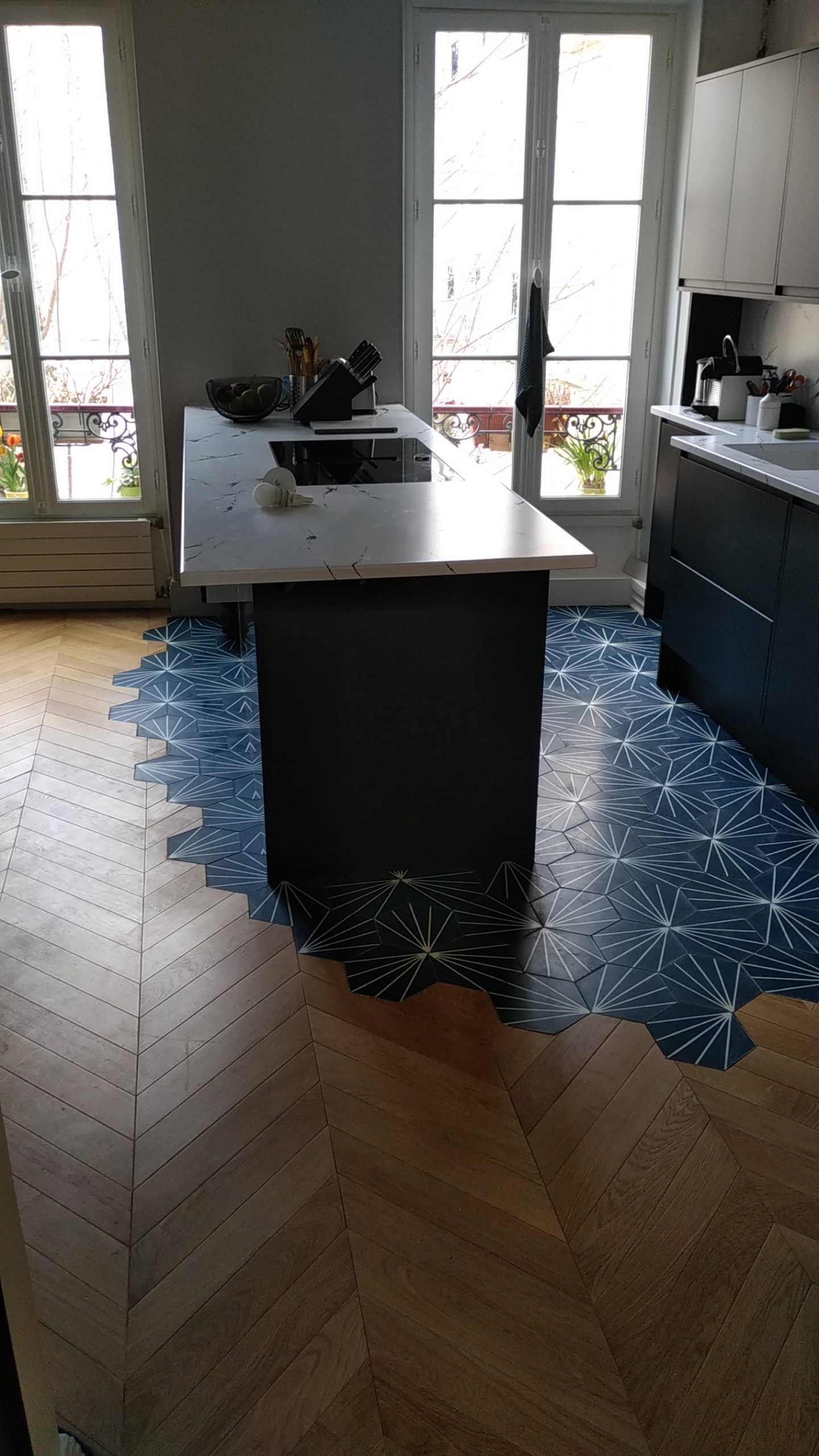
Beyond Quartz: A Surface With a Different Kind of Permanence
The market for quartz alternatives is crowded with materials that solve one problem while introducing another. Enameled lava stone is unusual in that it addresses quartz’s core weaknesses — heat sensitivity, limited customisation, engineered aesthetics, finite lifespan — without trading them for new ones.
It is a natural volcanic material. It is hand-crafted by specialist artisans in Auvergne. It is available in any colour, any finish, any dimension. It requires no maintenance beyond a cloth and water. And it has a documented track record, in public buildings across France, of lasting more than a century without degradation.
That is a different kind of permanence from what quartz offers. It is worth considering seriously.
Choose enameled lava stone for your next project
For architects, interior designers, and homeowners looking beyond standard quartz surfaces, enameled lava stone offers a rare combination of volcanic origin, bespoke colour, artisanal craftsmanship, and exceptional durability.
Tradition Pierre supports projects in France and abroad with made-to-order lava stone countertops, technical expertise, and the enduring excellence of French craftsmanship.
Frequently Asked Questions
There is no single best alternative: the right choice depends on the priorities of the project. Granite is suited to natural stone, marble to veining, porcelain to contemporary surfaces, concrete to mineral aesthetics, sintered stone to technical performance, and enameled lava stone to projects that combine natural material, customization, and craftsmanship.
Enameled lava stone is fired at 960°C during production, allowing it to withstand a hot pan or dish placed directly on the surface without leaving marks.
Enameled lava stone is particularly well suited to outdoor use thanks to the UV stability of its vitrified enamel and the resistance of volcanic basalt to changing weather conditions.
Enameled lava stone offers several custom-formulated shades, with the possibility of creating a color specifically for the project — a level of flexibility that no other countertop material offers.
A damp cloth is enough. Vitrified enamel has zero porosity, and no treatment is ever required.
Between four and eight weeks, depending on the specifications, as each piece is made to order in a workshop in Auvergne.